We earn a commission if you buy through our links, at no extra cost to you.
Comparison
Best Binoculars for 2026: Ranked Picks for Every Use
Ten binoculars ranked by use: birding, hunting, boating, astronomy and travel. We compare field of view, weight, eye relief and warranty from maker specs.
B By the Best Binoculars editorial team ·Published
At a glance
Start with the Swarovski NL Pure 10x42, which has the widest field of the 10x42 models at about 399 ft at 1,000 yards. The Zeiss SFL 8x40 is the light pick for birding at 22.6 oz, and the Vortex Viper HD 10x42 is a mid-range 10x42 for hunters.
We compared published specs, not performance in the field, because we do not use the products. Here is how we weighed the numbers.
8x versus 10x. 8x is steadier and gives a wider field and brighter exit pupil, which suits birding. 10x reaches farther, which suits open country and hunting.
Objective size and exit pupil. Divide the objective by the power. A 10x42 has a 4.2 mm exit pupil, an 8x42 has about 5.25 mm, and a 28 mm 8x compact has 3.5 mm. Bigger pupils help in dim light.
Field of view. Measured in feet at 1,000 yards. A wider field makes moving birds and animals easier to find.
Eye relief. Glasses wearers should look for about 15 mm or more. We use the maker’s figure.
Close focus. Short distances matter for butterflies and feeders. We list it when the maker does.
Weight. Under 25 oz is comfortable all day; over 30 oz calls for a harness.
Sealing and warranty. Waterproof, fogproof construction and a clear warranty matter in the field. Terms differ, so read them.
We rank the models by overall suitability for most buyers, with premium all-rounders first, then lighter and mid-range choices, then specialist models. Where a number reads “n/a,” we did not find it on a page we opened.
Summary Table
#
Binocular
Magnification x objective
Field of view (ft at 1,000 yd)
Weight (oz)
Eye relief
Best for
1
Swarovski NL Pure 10x42
10x42
about 399
29.6
n/a
Premium all-round, birding, hunting
2
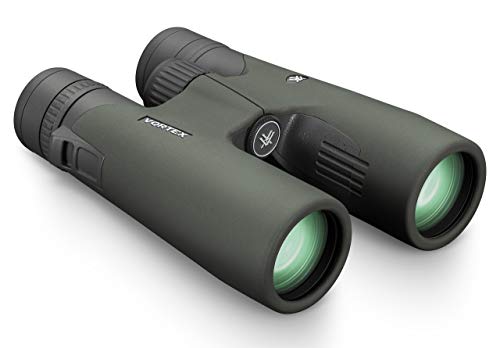
Vortex Razor UHD 10x42
10x42
346
32.2
16.7 mm
Long glassing, western hunting
3
Zeiss SFL 8x40
8x40
420
22.6
18 mm
Birding, light carry
4
Zeiss Conquest HDX 10x42
10x42
345
25.2
18 mm (Zeiss shop)
Hunting and birding all-rounder
5
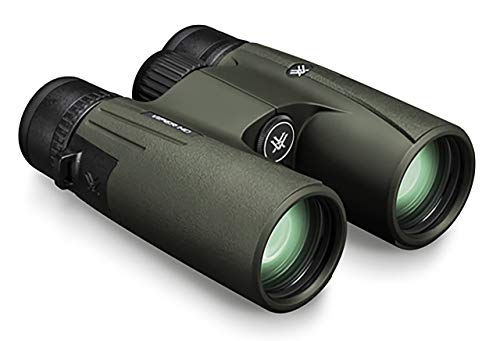
Vortex Viper HD 10x42
10x42
341
24.9
17 mm
Hunting, mid-range all-round
6
Leupold BX-4 Pro Guide HD Gen 2 8x42
8x42
376
24.5
18 mm
Birding and hunting, portability
7
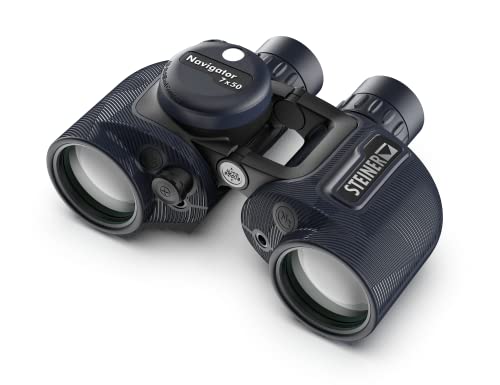
Steiner Navigator 7x50 with Compass
7x50
about 384
about 39
20.2 mm
Boating
8
Vortex Diamondback HD 10x42
10x42
330
21.3
15 mm
Deer hunting, first serious pair
9
Vortex Diamondback HD 8x28
8x28
332
13.7
18 mm
Cruises, concerts, travel
10
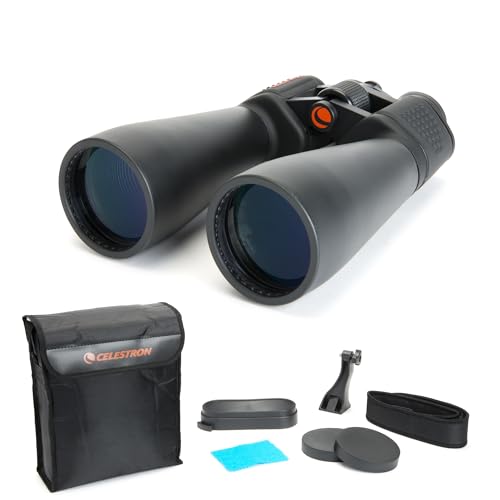
Celestron SkyMaster 15x70
15x70
231
48
18 mm
Astronomy from a tripod
Fields for Swarovski and Steiner are converted from meters at 1,000 m. Zeiss lists the Conquest HDX with two eye relief figures, 16.5 mm on its line page and 18 mm on its shop page.
1. Swarovski NL Pure 10x42 — The Widest View in a 10x42
Swarovski lists the NL Pure 10x42 with a field of about 399 ft at 1,000 yards (133 m at 1,000 m), or 7.6 degrees. That is the widest field among the 10x42 models we rank, and Swarovski says its field flattener lenses keep the edges sharp. The listed light transmission is 91%, and the body weighs 29.6 oz (840 g) with a wasp-waist grip that Swarovski designed for long viewing sessions. A forehead rest is optional and sold separately.
The trade-off is missing information, not just cost. The Swarovski pages we opened do not give eye relief or close focus, so we cannot tell you whether it suits glasses or feeder watching. It also sits in the top price class of this group. It suits buyers who want one 10x42 for birding, hunting and travel and who value a wide, flat image above all. Read the full Swarovski NL Pure 10x42 profile for the details.
2. Vortex Razor UHD 10x42 — A Heavy, Unconditional Warranty
The Razor UHD pairs Abbe-Koenig prisms with APO lenses and a magnesium chassis. Vortex lists a 346 ft field at 1,000 yards (6.6 degrees), 16.7 mm of eye relief and a 4.5 ft close focus, which is the shortest close focus listed for any 10x42 in this group. Vortex also lists argon purging and its unlimited, unconditional lifetime VIP warranty.
The price of that glass is weight: 32.2 oz is a lot to carry on a neck strap for a day, so most owners will want a harness. Vortex points this model at long glassing sessions and western hunting. If weight is not a concern and you like a warranty with no conditions attached, this is the Swarovski alternative to consider. See the Vortex Razor UHD 10x42 profile.
3. Zeiss SFL 8x40 — The Light, Wide Birding Binocular
Zeiss built the SFL for birders who want to travel light. It lists 22.6 oz (640 g), a 420 ft true field at 1,000 yards and 90% light transmission, and the shop page lists 18 mm of eye relief and a 4.9 ft close focus. The SmartFocus wheel takes 1.4 turns from close focus to infinity, which makes it quick when you swing from a nearby warbler to a distant hawk.
The Zeiss table also shows 60 degrees, but that is the apparent field of view, so we compare 420 ft instead. At 8x40 the exit pupil is 5.0 mm, a good match for dawn and dusk. The warranty is a transferable limited lifetime warranty plus a five-year no-fault policy, per the Zeiss shop. The cost is reach: it will not pull in distant targets like a 10x. See the Zeiss SFL 8x40 profile.
4. Zeiss Conquest HDX 10x42 — The Rugged All-Rounder
The Conquest HDX 10x42 lists a 345 ft field, 25.2 oz (715 g) and a magnesium housing with full rubber armor. Zeiss lists 90% light transmission, T* and LotuTec coatings, nitrogen purging and waterproof, fogproof and shockproof construction. The shop page adds a transferable limited lifetime warranty and a five-year no-fault policy.
Two cautions. Close focus is 6.6 ft, which is long for butterflies or a feeder close by. And Zeiss shows 16.5 mm as exit pupil distance on its line page but 18 mm of eye relief on its shop page, so glasses wearers should try a pair or ask Zeiss. It sits below the SFL and Swarovski in cost and above the mid-range Vortex models. See the Zeiss Conquest HDX 10x42 profile.
5. Vortex Viper HD 10x42 — The Mid-Range Hunting Workhorse
Vortex lists the Viper HD 10x42 at 341 ft at 1,000 yards (6.5 degrees), 17 mm of eye relief, a 6.0 ft close focus and 24.9 oz. The glass is HD with XR Plus coatings, dielectric prism coatings and phase correction, and the body is argon purged and ArmorTek coated. It is tripod adaptable and carries the same unlimited, unconditional lifetime warranty as the Razor.
Compared with the Razor, it weighs about 7 oz less but lists less premium glass; compared with the Diamondback HD 10x42 it adds about 3.6 oz and 2 mm of eye relief. It is a sensible middle step for hunters and all-round users. See the Vortex Viper HD 10x42 profile.
6. Leupold BX-4 Pro Guide HD Gen 2 8x42 — A Wide, Bright 8x42
Leupold lists a 376 ft field at 1,000 yards (7 degrees), a 5.25 mm exit pupil, 18 mm of eye relief and 24.5 oz in an open-bridge roof prism body. It has twist-up eyecups, a Guard-ion hydrophobic coating and a built-in 1/4-20 tripod port. Leupold pitches it at hunters who value portability over power, and its field suits birders as well.
The weak point is close focus: 8.7 ft is the longest of the 42 mm models we rank, so feeder watchers should look elsewhere. At 8x you also get less reach than a 10x42. See the Leupold BX-4 Pro Guide HD Gen 2 8x42 profile.
7. Steiner Navigator 7x50 with Compass — The Marine Pick With a Compass
This is a different kind of binocular: a 7x50 porro design built for boats. Steiner lists a 7.14 mm exit pupil, a field of about 384 ft at 1,000 yards (128 m at 1,000 m) and 20.2 mm of eye relief, which is the longest in our group. The illuminated, fluid-damped compass shows a bearing mark, and the auto-focus stays sharp from about 66 ft (20 m) to infinity, so you do not refocus as you scan the horizon. It is waterproof to about 16 ft (5 m) and nitrogen filled.
At about 39 oz (1,115 g) it is heavy, but weight matters less on a boat. Steiner’s own product page on its German store lists a 10-year warranty; US buyers should confirm the terms that apply to them. See the Steiner Navigator 7x50 with Compass profile.
8. Vortex Diamondback HD 10x42 — The Budget-Friendly 10x42
Vortex lists 330 ft at 1,000 yards (6.3 degrees), 15 mm of eye relief, a 5.0 ft close focus and 21.3 oz, the lightest 10x42 in the group. It has HD glass, dielectric prism coatings, argon purging and tripod adaptability, and a GlassPak harness comes in the box. The warranty is the same unlimited, unconditional lifetime warranty as the pricier Vortex models.
The shorter eye relief and narrower field are the visible compromises. As a first serious pair for deer season, it is the best value among our picks. See the Vortex Diamondback HD 10x42 profile.
9. Vortex Diamondback HD 8x28 — The Pocket-Sized Travel Pair
At 13.7 oz, this is the lightest binocular here by a wide margin. Vortex lists a 332 ft field at 1,000 yards (6.2 degrees), 18 mm of eye relief and a 6.0 ft close focus, and a soft case is included. The 28 mm objectives give a 3.5 mm exit pupil (28 divided by 8), so it is less bright at dusk than a 42 mm model.
It is the easiest pair to take on a cruise, to a concert or on a hike, and the same lifetime warranty applies. See the Vortex Diamondback HD 8x28 profile.
10. Celestron SkyMaster 15x70 — The Sky-Watching Specialist
Celestron lists 15x magnification, 70 mm porro objectives, a 4.4 degree field (231 ft at 1,000 yards), a 4.7 mm exit pupil, 18 mm of eye relief, a 43 ft close focus and 48 oz. A tripod adapter is included, and Celestron says the binocular is water resistant, multi-coated and not nitrogen filled, with a limited lifetime warranty.
It is built for the Moon, star clusters and wide star fields, and at 15x and 48 oz you need a tripod. It does not make sense for birding or boating. See the Celestron SkyMaster 15x70 profile.
8x is steadier in the hand, has a wider field and a brighter exit pupil, which suits birding and walking. 10x reaches farther, which suits open country and glassing hillsides. Among our picks, the 8x42 Leupold lists a 376 ft field and the 10x42 Diamondback HD lists 330 ft.
Do I need 42 mm objectives?
Not always. 42 mm lenses give a larger exit pupil (4.2 mm at 10x, 5.25 mm in the Leupold 8x42), which helps at dawn and dusk. A 28 mm model such as the Vortex Diamondback HD 8x28 is far lighter at 13.7 oz and works well in daylight, at concerts and on cruises.
Which binoculars work for eyeglass wearers?
Look for longer eye relief. The Steiner Navigator lists 20.2 mm, while the Zeiss SFL 8x40, Leupold BX-4 Pro Guide, Diamondback HD 8x28 and Celestron SkyMaster list 18 mm. The Diamondback HD 10x42 lists 15 mm, so try it with your glasses first.
Which binoculars are best for a cruise or boat?
For a boat deck, the Steiner Navigator 7x50 with Compass adds a compass and auto-focus and is waterproof to about 16 ft. For a cruise ship, a lighter pair such as the Vortex Diamondback HD 8x28 at 13.7 oz is easier to carry ashore.
Can I use binoculars for stargazing?
Yes. The Celestron SkyMaster 15x70 is built for it, with 70 mm lenses and a tripod adapter. At 15x and 48 oz, plan to mount it on a tripod, since hand shake is magnified.
Do these binoculars have a warranty?
Yes. Vortex lists an unlimited, unconditional lifetime warranty, Zeiss lists a transferable limited lifetime warranty with a five-year no-fault policy, and Celestron lists a limited lifetime warranty. Read the terms before you buy.