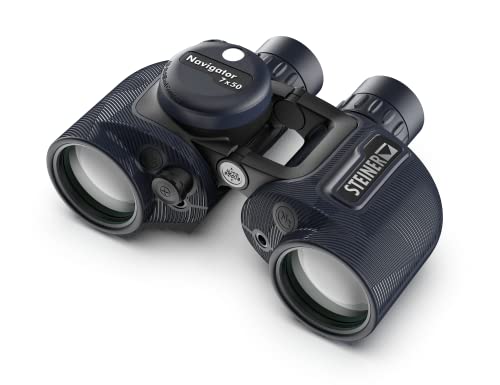
The Steiner Navigator 7x50 with Compass belongs to a narrow category: the marine binocular. Where most binoculars compete on being lighter, brighter or wider, this one competes on how well it behaves on a moving boat. It has big 50 mm lenses and a modest 7x magnification, a built-in lighted compass and an Auto-Focus system so you never fumble with a focus wheel. This profile covers what Steiner publishes, who the Navigator suits and who is better off with a lighter 8x42 or a compact pair. It sits near the bottom of our ranking of the best binoculars of 2026 only because most readers are not buying for a boat. For a boater, the logic changes.
A naming note. Steiner’s own model name is Steiner Navigator 7x50c, article number 23430920, which Amazon lists as the 2343 new version. We call it the Steiner Navigator 7x50 with Compass. We are the Best Binoculars editorial team and we compared specifications; we did not use the binocular ourselves. Steiner’s U.S. site blocks automated readers, so the specifications below come from the English product page on Steiner’s German store, steiner.de.
Key Specs at a Glance
| Spec | Steiner Navigator 7x50 with Compass |
|---|
| Magnification | 7x |
| Objective lens diameter | 50 mm |
| Exit pupil | 7.14 mm |
| Field of view | About 384 ft at 1,000 yd (128 m at 1,000 m) |
| Eye relief | 20.2 mm |
| Eye distance (IPD) | 56 to 72 mm |
| Diopter range | plus or minus 5 |
| Twilight factor | 18.7 |
| Focus | Steiner Auto-Focus, about 66 ft (20 m) to infinity |
| Compass | HD-stabilized, fluid damped, illuminated, with bearing mark |
| Gas filling | Nitrogen, 2-way valve |
| Waterproof | Up to about 16 ft (5 m) |
| Operating range | -4 to 158 degrees F (-20 to +70 degrees C) |
| Weight | About 39 oz (1,115 g) |
| Size | About 8.2 x 5.5 x 3.4 in (208 x 140.5 x 87 mm) |
| Included | Comfort carrying strap, lens covers, rain cover, bag, CR 1225 battery |
Optics and Field of View
A 7x50 binocular produces a 7.14 mm exit pupil, since 50 divided by 7 is about 7.1. That is as wide as or wider than most eyes can use, so the image stays bright and the eye can sit slightly off-axis without the view blacking out. That forgiveness is a real advantage when the deck is moving and your head is bobbing. The 7x power is also a deliberate choice: lower magnification means less visible hand shake, and Steiner says on its page that 7x ensures blur-free images for identifying buoys, beacons and bridge numbers even in rough weather at sea.
Steiner lists a field of view of about 384 ft at 1,000 yd (128 m at 1,000 m). For perspective, that is slightly wider than the 376 ft listed for the Leupold BX-4 Pro Guide HD Gen 2 8x42. The Navigator is a porro-prism design, which gives the body its classic wide shape and, in general, a strong sense of depth. Steiner lists 20.2 mm of eye relief with soft cylindrical eyecups, enough room for most eyeglass wearers.
The Navigator’s optical claims are modest and specific: high-contrast, high-performance optics, with consistently sharp images credited to the Auto-Focus. We have no independent resolution or transmission numbers for this model, and Steiner does not publish a transmission percentage on the page we opened, so we make no claim about glass quality relative to our premium picks. Its job is to be easy and reliable, not to win a lab comparison.
The Compass
The headline feature is the compass. Steiner describes a large, liquid-damped, shock-absorbing compass that is HD-stabilized, with a bearing mark, and which can be illuminated to help you determine course at night. Steiner says the compass has a new design in this generation of the Navigator. The practical benefit is that you can take a bearing on a landmark or another vessel while you are already looking at it, rather than swinging a separate hand-bearing compass into position.
Two caveats. The illumination uses a CR 1225 battery per Steiner’s specification, so keep a spare aboard. And the compass is a convenience: it is not a replacement for your boat’s installed compass, charts or electronics.
Auto-Focus and Handling
Steiner’s Auto-Focus is the other defining feature. Steiner says that once set to your eyes, it delivers sharp images from about 66 ft (20 m) to infinity without refocusing. There is no center wheel; you set your diopter correction once (the range is plus or minus 5) and then simply raise the binocular. That is attractive on a bouncing boat, or for a passenger who is not used to fiddling with binoculars. The trade-off is that nothing closer than about 66 ft will be sharp, so this is not a pair for watching a sparrow at a feeder.
The body is wide and heavy. Steiner lists about 39 oz (1,115 g), which is more than 14 oz heavier than the Leupold BX-4 Pro Guide at 24.5 oz and nearly three times the weight of the 13.7 oz Vortex Diamondback HD 8x28. You would not want to hold it up for several minutes. Steiner’s page describes an Open Bridge System intended to make one-handed gripping easier, and a wave-textured rubber coating with water-repellent properties for a non-slip hold in rough seas. A comfort carrying strap, lens protection flaps, a rain cover and a bag are included, and Steiner sells floating straps separately in its marine accessories.
Weather Sealing and Warranty
Steiner lists waterproofing to about 16 ft (5 m) and nitrogen filling with 2-way valve technology. It states that this eliminates fogging or condensation inside the binoculars and that temperature swings between -4 and 158 degrees F (-20 and +70 degrees C) do not impair function. The valve design, according to Steiner, allows maintenance of the binoculars at any time, even after many years.
Waterproof does not mean floating. Binoculars sink, and a strap that floats or a lanyard attached to the boat is the sensible precaution if you plan to use them near water.
On the warranty, Steiner’s own English product page on its German store lists a 10-year manufacturer warranty. That page is for the German market. If you buy in the United States, confirm directly with Steiner what warranty terms apply to the unit you receive and where to send a claim. Do not assume the German listing governs a purchase made here.
Optics Are Not Navigation
A word on use at sea. A good binocular helps you read buoy numbers and spot traffic, but it does not stand in for proper seamanship. US Inland Navigation Rule 5, reproduced in 33 CFR 83.05, says every vessel must keep a proper lookout at all times by sight and hearing as well as by all available means appropriate in the prevailing circumstances, so as to make a full appraisal of the situation and of the risk of collision. A compass binocular is one more tool, not a promise of safe passage. For equipment requirements and rules for your waters, consult the US Coast Guard’s boating safety resources and your state boating agency.
Who It’s For
- Recreational boaters and sailors. The compass, the Auto-Focus and the waterproof, nitrogen-filled body are all aimed squarely at this group. Steiner describes the model as marine binoculars with compass for water sports enthusiasts and recreational sailors.
- Anyone who finds focus wheels frustrating. Set the diopter once and forget it.
- Low-light use near the water. A 7.14 mm exit pupil is generous at dusk.
How It Compares
Next to the compact Vortex Diamondback HD 8x28 or a full-size roof prism like the Leupold BX-4 Pro Guide HD Gen 2 8x42, the Navigator is bigger, heavier and more specialized. It trades portability for a compass, a steady 7x view and an exit pupil wide enough for twilight. For most land-based uses, one of those lighter roof-prism models will be easier to live with. See the full lineup in our binocular ranking.
Who Should Skip It
- Birders and hikers. The weight, the 66 ft minimum focus and a body shaped for the deck of a boat will frustrate on a trail.
- Cruise passengers and concertgoers. At about 39 oz, it is far larger than anyone needs for a stateroom balcony.
- Anyone who needs adjustable close focus. Auto-Focus has no focus wheel.
- Buyers who do not need a compass. Without one, a conventional waterproof roof prism in 7x50 or 8x42 may serve better.
Where to Buy
See the current price and availability on Amazon. Make sure the listing shows the Navigator 7x50 with compass, the 2343 new version, and not a model without a compass.
Sources