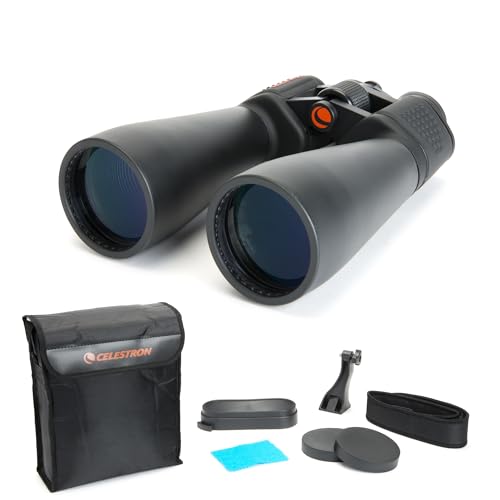
When shoppers search for “binoculars for adults high powered astronomy,” the Celestron SkyMaster 15x70 is the kind of product they find: big front lenses, a big number before the “x,” and an approachable price tier. It is a purpose-built stargazing binocular and does not pretend to be anything else. It is also one of the heaviest, narrowest and least weatherproof pairs in our ranking of the best binoculars of 2026, which is why it sits at the bottom of the list. For a person who wants to look at the sky from a backyard, it can make sense. For nearly anyone else, it will disappoint.
We are the Best Binoculars editorial team. We compared specs from Celestron’s own product page and did not use the binocular ourselves, so we do not describe what you will see through it. We do not quote prices.
Key Specs at a Glance
All figures are from Celestron’s product page for the SkyMaster 15x70mm porro binoculars.
| Spec | Celestron SkyMaster 15x70 |
|---|
| Magnification | 15x |
| Objective lens diameter | 70 mm (2.75 in) |
| Prism type | Porro, BaK-4 glass |
| Lens coatings | Multi-coated |
| Angular field of view | 4.4 degrees |
| Linear field of view | 231 ft at 1,000 yd (77 m at 1,000 m) |
| Exit pupil | 4.7 mm |
| Eye relief | 18 mm |
| Close focus | 43 ft |
| Interpupillary distance | 56 to 72 mm |
| Diopter range | -4 to +8 |
| Twilight factor | 32.4 |
| Weight | 48 oz (1,361 g) |
| Dimensions | 8.7 x 4.3 x 11.0 in |
| Environmental protection | Water resistant |
| Nitrogen filled | No |
| Tripod adaptable | Yes, adapter included |
| Case | Nylon carrying case |
What the Coatings Mean
Celestron lists lens coatings as multi-coated. That is a step below fully multi-coated, a term used by Vortex and Leupold for their models, where every air-to-glass surface carries multiple anti-reflective layers. Multi-coated usually means at least some surfaces have multiple layers and others do not. In practice, you should expect less contrast and more glare around bright objects than on a fully multi-coated binocular. Celestron lists prism coatings as not applicable and the prism glass as BaK-4, which is the better of the two common prism glasses and is standard on quality porro prism binoculars.
Why 15x70 for the Sky
Celestron’s marketing copy for the SkyMaster series calls the large-aperture models ideal for astronomical viewing or for terrestrial use, especially over long distances. The logic of a big binocular is simple. A 70 mm lens collects far more light than a 42 mm lens, and 15x magnification enlarges the Moon and clusters. Celestron lists the exit pupil at 4.7 mm and a twilight factor of 32.4, and gives limiting stellar magnitudes ranging from 9.73 in poor conditions to 11.73 in ideal conditions. Those are the maker’s figures, and your sky conditions will decide where you land.
The trade-off is a narrow 4.4 degree field. Compare that to the 7 degrees Leupold lists for its 8x42, or the 7.6 degree field Swarovski lists for the NL Pure 10x42. A narrow field makes it harder to find an object and hold it, and means you see less sky at once.
Handling: Tripod Strongly Advised
At 48 oz (exactly 3 lb), the SkyMaster is nearly twice the weight of the Leupold BX-4 Pro Guide HD Gen 2 8x42 at 24.5 oz and about three and a half times the 13.7 oz Vortex Diamondback HD 8x28. Add 15x magnification, which magnifies every tremor of your hands, and holding it up to your eyes for more than a minute or two is tiring. Stargazing makes it harder still, because you are pointing the binocular upward.
Celestron includes a tripod adapter and lists the binocular as tripod adaptable. We would treat a tripod as part of the purchase. A sturdy photo tripod with a fluid or ball head, or a dedicated binocular mount, will do far more for your viewing than any optical upgrade at this tier. Celestron sells a heavy-duty alt-azimuth tripod among its suggested accessories, but any stable tripod with a suitable head will do. If you are viewing from a lawn chair, lean back as far as you can and rest your elbows on the armrests.
The dimensions are 8.7 by 4.3 by 11.0 inches, so it is a bulky object that needs the nylon carrying case Celestron includes. The accessory list includes objective lens caps, a neck strap and a lens cloth.
Weather Protection and Warranty
This is where Celestron is plain: environmental protection is listed as water resistant, and nitrogen filled is listed as no. A nitrogen-filled, sealed binocular resists internal fogging; this one is not. That does not make it fragile, but it does mean you should not treat it like a marine or hunting binocular. Do not leave it out in dew or rain, let it come to outdoor temperature before use, and bring it indoors to a dry place when you are done. Internal fogging is most likely during cold-weather observing, so keep that in mind if you live in the northern states.
Celestron advertises a limited lifetime warranty. A limited warranty comes with conditions, so read the terms on Celestron’s warranty page before assuming any particular repair or replacement is covered.
Who It’s For
- Backyard stargazers on a budget who will use a tripod. The 70 mm aperture, the 15x power and the included tripod adapter point at this reader.
- Anyone who wants a first large binocular for the Moon and star fields and is comfortable with its limits.
- People who want a second instrument alongside a small telescope. Binoculars are fast to set up and easy to sweep across a sky.
How It Compares
If you want a binocular to carry, compare it with the Vortex Diamondback HD 10x42, which weighs 21.3 oz and offers a 330 ft field. If you want a binocular that stays sharp on a boat or in rain, see the weather-sealed models in our best binoculars of 2026. For sky watching, there is no real substitute for large aperture, but for everything else the SkyMaster is outclassed by lighter roof-prism models.
Who Should Skip It
- Birders. A 231 ft field and 43 ft close focus make birds hard to find and impossible to see up close.
- Hikers, hunters and travelers. 48 oz is a lot to carry, and there is no weather sealing to count on.
- Boaters. Water resistant and not nitrogen filled is not a marine spec. See the marine-minded model in our ranking.
- Anyone who will not use a tripod. At 15x and 3 lb, handheld viewing is tiring and the image will jump.
- Buyers who want a fully multi-coated binocular. Celestron lists multi-coated optics.
Where to Buy
You can check the current price and availability on Amazon. Make sure the listing says SkyMaster 15x70, not the 12x60 or the 15-35x70 zoom, which are different models.
Sources