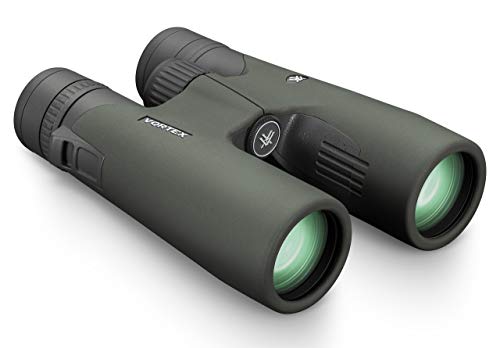
The Vortex Razor UHD 10x42 is the premium end of Vortex’s binocular line, built for people who glass for long hours and expect the glass to keep up. It ranks second in our binocular ranking for 2026, just behind the Swarovski. This profile covers what Vortex says about the model, where its weight and field of view land against its rivals, and who is likely to be happier with a lighter or cheaper pair.
We have not handled this binocular. Every number below is taken from the Vortex product page for the Razor UHD 10x42, or from the other manufacturers’ pages when we compare. We do not state a figure that those pages do not give.
Who It’s For
Vortex lists western hunting and wildlife observation as the recommended uses, and describes the Razor UHD as the peak of its optical technology, with “spectacular glass, rugged construction and unmatched low-light performance.” Treat that as marketing language. Still, the use case is clear: someone sitting on a ridge at first light, judging distant animals, who values low-light performance and does not want to worry about breaking the binocular.
That describes a western or open-country hunter, a wildlife watcher who spends whole mornings on elk, sheep or birds at range, and a serious birder who prefers 10x to reach distant shorebirds and raptors. It also describes anyone who wants an unconditional warranty on an expensive purchase, which is where Vortex stands apart from many rivals.
Key Specs
| Spec | Razor UHD 10x42 |
|---|
| Magnification | 10x |
| Objective lens | 42 mm |
| Exit pupil (42 mm divided by 10x) | 4.2 mm |
| Eye relief | 16.7 mm |
| Angular field of view | 6.6 degrees |
| Linear field of view | 346 ft at 1,000 yd |
| Close focus | 4.5 ft |
| Interpupillary distance | 56 to 76 mm |
| Height / width | 7.0 in / 5.6 in |
| Weight | 32.2 oz |
| Prism | Abbe-Koenig |
| Chassis | Magnesium |
| Gas fill | Argon, O-ring sealed |
As with our other profiles, the exit pupil is arithmetic from magnification and lens size, not a Vortex-listed spec.
Optics and Field of View
Vortex calls the optical package the UHD Optical System: ultra high definition glass meant to cut chromatic aberration, with APO (apochromatic) index-matched lenses that correct color across the visible spectrum. XR Plus lens coatings are applied to all air-to-glass surfaces for light transmission, and phase correction coating on the roof prism is listed as improving resolution and contrast. The Abbe-Koenig prism is described as a larger prism with a longer optical path for sharper resolution. Vortex also lists Plasma Tech, a coating application process it says improves coating durability and performance, and ArmorTek, a hard coating on the outer lenses to resist scratches, oil and dirt.
Vortex does not list a light transmission percentage on the page we opened, so we cannot compare it directly with the 91% that Swarovski lists for the NL Pure or the 90% Zeiss gives for the SFL and Conquest HDX. What we can compare is the field: 346 ft at 1,000 yd for the Razor against about 399 ft for the Swarovski NL Pure 10x42, 345 ft for the Zeiss Conquest HDX 10x42, and 341 ft for the Vortex Viper HD 10x42. The Razor is in line with the others in its class, and it is clearly narrower than the Swarovski.
Close focus is 4.5 ft, which is useful for a binocular that is also used for butterflies, dragonflies and other near subjects. The Viper HD 10x42 lists 6.0 ft, so the Razor lets you work closer.
Handling and Weight
Weight is the trade-off. At 32.2 oz, the Razor UHD is heavier than every other 10x42 in our ranking, according to the manufacturers: 29.6 oz for the Swarovski, 25.2 oz for the Conquest HDX and 24.9 oz for the Viper HD. Vortex lists a magnesium chassis, which it says decreases weight and increases strength, and a True Open Hinge design that it says offers better ergonomics with less bulk. Even so, 32 oz is a heavy load to hang from your neck. The GlassPak Pro harness in the box is the first accessory many buyers reach for, because it spreads the load across the shoulders instead of the neck.
Other handling details from Vortex: a center focus wheel adjusts both barrels, a locking diopter on the right eyepiece keeps your correction in place, and the twist-up eyecups work with or without eyeglasses. Eye relief is 16.7 mm, a bit shorter than the Zeiss SFL 8x40 at 18 mm (according to Zeiss) and the Viper HD at 17.0 mm (per Vortex), so eyeglass wearers should try a pair before committing. The interpupillary distance range is 56 to 76 mm.
The binocular is also listed as tripod adaptable. A heavy 10x binocular is hard to hold perfectly still for minutes at a time, and mounting it on a tripod through the separate adapter is the usual answer for glassing sessions on a hillside.
Weather Sealing and Warranty
Vortex describes the Razor UHD as waterproof, fogproof and shockproof. The binocular is argon-gas purged and O-ring sealed, and the outer surfaces carry rubber armor for grip and protection. Vortex does not publish a depth rating on the page we opened, so we will not give one.
The warranty is the standout. Vortex states “unlimited, unconditional lifetime warranty” for its VIP program. We have not read the full terms, so we cannot describe edge cases, but the headline promise is stronger than a typical limited warranty. For a binocular that is likely to be used in rough terrain, that matters.
In the box, per Vortex: the GlassPak Pro harness, a comfort neck strap, a rangefinder pouch, tethered objective lens covers, a rainguard eyepiece cover and a lens cloth.
How It Compares
The Swarovski NL Pure 10x42 is the model above it in our ranking. Swarovski lists a wider field, 91% light transmission and a lighter 29.6 oz body, while Vortex counters with a warranty and a close focus figure that Swarovski does not publish on the pages we opened. If you are choosing mainly on optics and handling, the Swarovski has the edge on paper. If you want an unconditional warranty and a lower price of entry into premium glass, the Razor makes a strong case.
The Vortex Viper HD 10x42 is the sensible step down. It is 7.3 oz lighter, has nearly the same field of view, and carries the same warranty. The Viper page does not list the UHD system, an Abbe-Koenig prism or a magnesium chassis, and close focus drops from 4.5 ft to 6.0 ft. For many hunters, the lighter weight is worth more than the extra glass.
For birding, the Zeiss SFL 8x40 is a very different pitch: 8x, 22.6 oz and a 420 ft field. If you are on your feet all day, it will feel easier to carry than the Razor.
Who Should Skip It
Skip the Razor UHD if weight bothers you. If you are a hiker, a traveler or a birder who walks miles, 32.2 oz in the hand and around the neck is a serious penalty, and a lighter binocular will get used more often. Skip it if your budget is under $1,000, since the Viper HD and other mid-range models cover most hunting needs. And skip it if your top priority is the widest possible field, because the Swarovski is wider on paper.
You can compare all ten models in our full ranking, or see the Vortex Razor UHD 10x42 on Amazon to check current pricing and availability.
Sources