We earn a commission if you buy through our links, at no extra cost to you.
Best Binoculars for Boating and Cruises
Marine binoculars for boating and travel binoculars for a cruise ship: why 7x50 suits a moving deck, when 8x28 or 8x40 is easier, and three models to consider.
At a glance
For boating, the Steiner Navigator 7x50 with Compass pairs a steady 7x with a 7.14 mm exit pupil and a lighted compass, at about 39 oz. For cruises, the Vortex Diamondback HD 8x28 is a 13.7 oz pocket pair, and the Zeiss SFL 8x40 is a light, bright step up. Binoculars do not replace a proper lookout.


Boaters and cruise passengers both search for binoculars, but they need different tools. A boater holds a pair on a deck that pitches and rolls, in spray and in glare. A cruise passenger wants something light for a balcony, a rail and a day ashore. The same spec sheet reads very differently in each case.
This guide explains the logic behind marine binoculars and travel binoculars, then compares three models from our 2026 binocular ranking. We compared manufacturers’ published specifications and boating press coverage. We did not use the binoculars ourselves.
Binoculars Are a Tool, Not a Substitute for a Lookout
First, a safety point. The U.S. Navigation Rules (Rule 5, codified at 33 CFR 83.05 and published by Cornell’s Legal Information Institute) require every vessel to keep a proper look-out by sight and hearing as well as by all available means appropriate in the prevailing circumstances and conditions, so as to make a full appraisal of the situation and of the risk of collision. Binoculars help you read a buoy, spot a landmark or identify a vessel. They do not replace watching, listening or your navigation equipment. We make no safety claim for any binocular in this guide.
Marine Binocular Logic: Why 7x50
Boating Magazine says the standard boating binocular is a 7x50. It gives two reasons. Any magnification above 7 is too hard to hold steady, and any objective wider than 50 mm is too heavy to hold comfortably. Dividing 50 by 7 gives a 7 mm exit pupil, about the size of a young adult’s pupil, according to the same article, which also says a 50-year-old’s pupil is about 4 mm. So a 7x50 gives a generous, forgiving bright spot at the eyepiece, which makes it easier to keep a steady view when the deck moves.
A lower power also gives a wider field and a calmer picture. That is the logic, but it does not mean every boater needs a 7x50. On a large, stable vessel, an 8x binocular is a reasonable compromise.
Features That Matter on the Water
- Waterproof and sealed. Spray, rain and humidity are routine. Look for a sealed body with a gas fill. The Steiner Navigator lists waterproofing to about 16 ft (5 m) and a nitrogen filling with a 2-way valve.
- Compass. Optional, but handy for taking a bearing on a landmark.
- Easy focus. An auto-focus or fast wheel saves fumbling when a target is moving.
- Eye relief. If you wear glasses or sunglasses, look for at least 15 mm.
- A strap or lanyard. Waterproof does not mean floating. A floating strap or a lanyard clipped to the boat keeps it from going overboard.
Our Picks
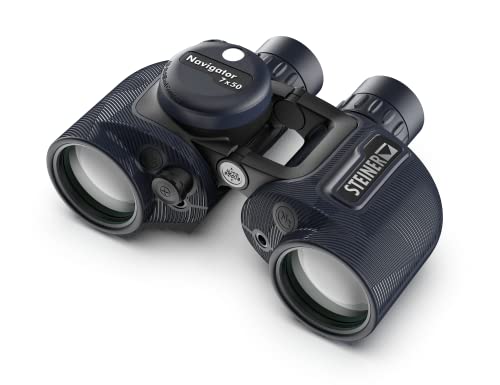
Steiner Navigator 7x50 with Compass: The Marine Choice
A 7x50 porro with a 7.14 mm exit pupil, an illuminated compass and auto-focus, for boaters who want one purpose-built pair.
According to Steiner, this binocular has a 7x magnification and 50 mm objectives, a 7.14 mm exit pupil, a 384 ft field at 1,000 yards (128 m at 1,000 m), 20.2 mm of eye relief and an HD-stabilized, fluid-damped, illuminated compass with a bearing mark. The Steiner Auto-Focus runs from about 66 ft (20 m) to infinity. Steiner lists waterproofing to about 16 ft (5 m), a nitrogen filling with a 2-way valve and an operating range of -4 to 158 degrees F (-20 to +70 degrees C). A rain cover, a bag and a comfort strap are in the box.
It is heavy. Steiner lists about 39 oz (1,115 g), which is not something to hold up for minutes at a time. Steiner’s own German-market product page lists a 10-year warranty, so US buyers should confirm US warranty terms with Steiner before buying. It is a mid-range purchase, and it is the one in this guide built for boating. See the Steiner Navigator 7x50 with Compass profile.
Vortex Diamondback HD 8x28: The Compact Cruise Pair
A 13.7 oz 8x with a soft case, for cruise cabins, balconies and shore excursions.
Vortex lists 13.7 oz, a height of 4.6 inches, a 332 ft field at 1,000 yards, 18 mm of eye relief and a 6 ft close focus. It is argon purged and O-ring sealed for waterproof and fogproof use, and a soft case is included. Vortex also lists an unlimited, unconditional lifetime warranty. It is the entry-level pick in our ranking, small enough for a day bag. The 28 mm objective will not match a larger pair at dusk, so treat it as a daylight pair for decks, ports and scenery. The Vortex Diamondback HD 8x28 profile has the full spec table. After a day at sea, rinse salt off with fresh water and a soft cloth.
Zeiss SFL 8x40: The Light Step Up for Cruise Guests
A light 22.6 oz 8x40 with a 420 ft field and a nitrogen-filled body, for travelers who want one premium pair.
Zeiss lists 22.6 oz (640 g), a 420 ft field, 18 mm of eye relief, a 4.9 ft close focus and a nitrogen-filled body. It has a 5.0 mm exit pupil, so it is brighter than the 8x28 at dawn and dusk, which matters for sunrise at sea. It is a premium binocular, a bigger investment than a casual cruiser needs. It suits travelers who want one good pair for cruises, wildlife trips and birding. See the Zeiss SFL 8x40 profile.
Boat Deck or Cruise Ship: Why the Advice Differs
A small powerboat or sailboat moves with every wave, and your whole body moves with it. That is why low power and a large exit pupil matter so much there. A cruise ship is a much larger and steadier platform. On a ship, the limit is not the deck’s motion so much as weight, bag space and how long you want to hold the binocular up. A light 8x is easy to hold at a rail, and the wider field of a lower power helps you find a distant headland, a pod of dolphins or a harbor landmark before the ship moves on.
That is also why we do not suggest a heavy 7x50 for a cruise cabin. At about 39 oz it is a lot to carry through a port day. Likewise, we would not suggest a pocket 8x28 as the only pair on a sailboat that goes out at dusk. Match the binocular to the trip, not to a single rule.
Which One for Your Trip?
- You own a boat or sail, and want a compass and 7x50: the Steiner Navigator 7x50 with Compass.
- You are a cruise passenger with a small bag: the Vortex Diamondback HD 8x28.
- You want one bright travel pair for cruises and wildlife: the Zeiss SFL 8x40.
A few cruise-specific tips. Keep the strap around your neck at the rail, and do not lean over it. Pack a lens cloth, because salt air leaves a film. Check your cruise line’s current rules on what you can bring aboard, since we do not list them here.
Using Binoculars on Water
Brace your elbows against your body or a rail, and let your knees absorb the roll. Look at the horizon first, then raise the binocular without moving your eyes from the target. Keep sweeps slow. Between looks, lower the binocular and check the surroundings, since a narrow field can hide traffic and obstacles. That habit is the practical meaning of a proper lookout.
Sources
Frequently asked questions
Why is 7x50 the standard for boating?
Boating Magazine calls the standard boating binocular a 7x50 and says that magnification above 7 is too hard to hold steady, while an objective wider than 50 mm becomes too heavy to hold comfortably. A 7x50 also has a 7 mm exit pupil, which is a large, forgiving bright spot at the eyepiece.
Do binoculars replace a lookout or navigation equipment?
No. The Navigation Rules require every vessel to keep a proper look-out by sight and hearing as well as by all available means appropriate in the prevailing circumstances (33 CFR 83.05). Binoculars are one of those means, not a replacement for watching, listening or using your navigation equipment, and we make no safety promises about any model.
Do I need a compass in my binoculars?
It is a convenience, not a requirement. The Steiner Navigator 7x50 with Compass has an illuminated, fluid-damped compass with a bearing mark, according to Steiner. If you do not need one, a conventional waterproof 7x50 or 8x42 may serve you better, and the compass does not replace your boat's own navigation equipment.
Are waterproof binoculars the same as floating binoculars?
No. Steiner lists the Navigator as waterproof to about 16 ft (5 m) with a nitrogen filling, but waterproof does not mean it floats. A floating strap or a lanyard clipped to the boat is a simple way to avoid losing a pair overboard.
What binoculars should I bring on a cruise?
Most cruisers want something light that fits a day bag and works at a rail, from a balcony or on a shore excursion. The Vortex Diamondback HD 8x28 weighs 13.7 oz, and the Zeiss SFL 8x40 weighs 22.6 oz with a 420 ft field, per the makers. Check your cruise line's current rules on what you can bring aboard.
Can I use regular binoculars on a boat?
You can, but a high-magnification pair is hard to hold steady on a moving deck. Boating Magazine says 7x is about the most power that is easy to hold steady. An 8x model is a reasonable compromise on a larger, steadier vessel such as a cruise ship.